


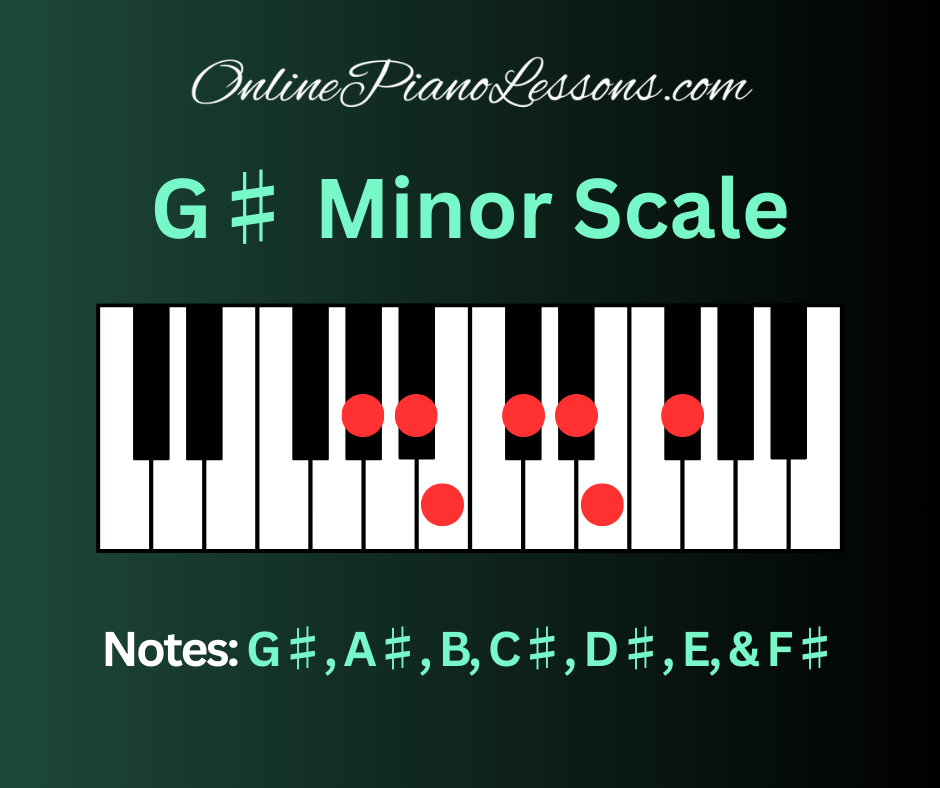
The G sharp minor scale is a beautifully expressive and somewhat mysterious scale that appears across classical piano literature, film music, and modern genres. Whether you’re learning scales for technique, improvisation, or composition, the G# minor scale offers a lush, dark, and emotionally deep sound that every pianist should know.
In this definitive guide, you’ll learn exactly what the G sharp minor scale is, how to find it on the piano, how it works in music theory, what it sounds like, and how to practice it effectively. Everything here is tailored for pianists who want clarity, precision, and a clear step-by-step path to fully understanding the G# minor scale on the piano.
What Is the G Sharp Minor Scale?
The G sharp minor scale is the natural minor scale built on the note G#. Its key signature contains five sharps: F#, C#, G#, D#, and A#. This makes the G# minor scale one of the sharper minor keys, but it’s surprisingly comfortable to play on the piano because it uses a natural mixture of black and white keys.
The natural G sharp minor scale consists of the following notes:
- G#
- A#
- B
- C#
- D#
- E
- F#
- G# (octave)
Like all natural minor scales, the G# minor scale follows the interval pattern:
Whole – Half – Whole – Whole – Half – Whole – Whole
This predictable pattern makes it possible to construct the G sharp minor scale from scratch on any instrument, but especially on the piano, where both whole steps and half steps are easy to visualize.
How to Find the G Sharp Minor Scale on the Piano
Finding the G sharp minor scale on the piano is simple once you can locate G#. On your keyboard, G# is the black key immediately to the right of G.
To play the natural G# minor scale, start on G# and follow the minor scale interval pattern:
- G#
- Whole step to A#
- Half step to B
- Whole step to C#
- Whole step to D#
- Half step to E
- Whole step to F#
- Whole step to G# (octave)
Mapping these notes helps you understand how the G sharp minor scale sits under your fingers on the piano, preparing you for more advanced forms of the scale.
The Three Forms of the G Sharp Minor Scale
Like all minor keys, the G sharp minor scale includes three different forms, each serving a musical purpose: natural, harmonic, and melodic. All three forms are important for understanding how melodies and harmonies behave in the G# minor scale on the piano.
1. G Sharp Natural Minor Scale
This is the foundational version of the scale.
Notes:
G# – A# – B – C# – D# – E – F# – G#
This is the form most students learn first when they begin playing the G sharp minor scale on the piano.
2. G Sharp Harmonic Minor Scale
To create the harmonic minor form, raise the 7th note (F# → F##).
Notes:
G# – A# – B – C# – D# – E – F## – G#
The raised 7th (F##), which sounds like G natural on the piano, creates an intense leading tone that gives the G# minor scale its distinctive classical flavor.
3. G Sharp Melodic Minor Scale
Ascending, raise both the 6th (E → E#) and 7th (F# → F##).
Descending, revert to natural minor.
Ascending:
G# – A# – B – C# – D# – E# – F## – G#
Descending:
G# – F# – E – D# – C# – B – A# – G#
The melodic G sharp minor scale is especially smooth and lyrical when played on the piano, lending itself well to expressive phrasing and improvisation.
How the G Sharp Minor Scale Works in Music
The G sharp minor scale plays a vital role in harmonic structure and melodic writing. Once you understand how the scale tones interact, playing or composing music in the G# minor scale becomes much more intuitive on the piano.
Primary Chords (Triads) in G# Minor:
- i (G# minor): G#–B–D#
- iv (C# minor): C#–E–G#
- v (D# minor): D#–F#–A#
With Harmonic Form (most common in classical music):
- V (D# major): D#–F##–A#
- ii° (A# diminished): A#–C#–E
Other Chords Derived from the Natural Scale:
- III (B major)
- VI (E major)
- VII (F# major)
Understanding these chords helps you know how melodies created from the G sharp minor scale fit together harmonically on the piano.
What the G Sharp Minor Scale Sounds Like
The G# minor scale is known for being:
- Dark
- Elegant
- Dramatic
- Serious
- Emotional
- Slightly tense
- Beautifully expressive
On the piano, it feels smooth due to the natural layout of black keys, which allow your hand to fall comfortably into the shape of the G sharp minor scale.
This scale frequently appears in:
- Classical piano compositions
- Cinematic scores
- Moody pop ballads
- Electronic music
- Ambient and atmospheric music
Its emotional resonance makes the G# minor scale a favorite choice when composers want depth or tension.
Classical Works in G Sharp Minor
Some examples of classical works that use or touch the G sharp minor scale include:
- Rachmaninoff’s Prelude in G# Minor, Op. 32 No. 12
- Scriabin’s Etude in G# Minor, Op. 8 No. 9
- Chopin’s Nocturne in G# Minor, Op. Posth.
These pieces showcase the expressive, dramatic potential of the G sharp minor scale on the piano, and they remain staples of advanced repertoire.
How to Practice the G Sharp Minor Scale on the Piano
To master the G sharp minor scale, you’ll want to practice it with a structured approach. Here are the most effective techniques for learning the G# minor scale on the piano:
Use Correct Fingering
This prevents hand tension and helps build muscle memory.
Right Hand (one octave):
2 – 3 – 4 – 1 – 2 – 3 – 4 – 1
Left Hand (one octave):
4 – 3 – 2 – 1 – 3 – 2 – 1 – 4
Using the same fingering every time makes the G sharp minor scale feel smooth, predictable, and fluid on the piano.
Practice Slowly at First
Never rush. Speed comes naturally after accuracy.
Use a Metronome
Start slowly and increase the tempo gradually. This builds consistency.
Practice Hands Separately Before Both Hands Together
This strengthens each hand’s independence when playing the G# minor scale on the piano.
Add Arpeggios to Your Routine
Arpeggios based on the G sharp minor scale improve precision and hand dexterity.
Incorporate Musical Phrasing
Try creating small melodies using notes exclusively from the G sharp minor scale—this builds improvisational confidence.
Common Mistakes When Learning the G Sharp Minor Scale
Here are the errors many players make while learning the G sharp minor scale on the piano:
- Confusing enharmonic spellings (F## vs. G natural)
- Using inconsistent fingering
- Forgetting to raise the 6th and 7th degrees in the melodic form
- Flattening the wrist too much over black keys
- Practicing without a metronome
- Trying to play too quickly too soon
Avoiding these pitfalls dramatically improves your fluency in the G# minor scale.
Why Pianists Should Learn the G Sharp Minor Scale
Mastering the G sharp minor scale offers several benefits:
- It strengthens black-key technique
- It improves your understanding of sharp keys
- It prepares you for advanced classical repertoire
- It develops hand coordination
- It enhances improvisation skills
- It deepens your overall musical understanding
If you’re committed to growing your skills on the piano, learning the G# minor scale is essential.
FAQ
Is the G sharp minor scale hard to play on the piano?
It’s moderately challenging because it uses several sharps, but it’s surprisingly comfortable due to the natural hand positions over the black keys on the piano.
How many sharps are in the G# minor scale?
The natural G sharp minor scale has five sharps: F#, C#, G#, D#, and A#.
Why does the harmonic version use F## instead of G?
Even though F## sounds like G on the piano, the spelling preserves theoretical structure and maintains proper scale degrees.
Do I need to learn all three forms of the scale?
Yes—the natural, harmonic, and melodic forms all serve different musical and technical purposes on the piano.
What chords come from the G sharp minor scale?
The main chords are G# minor, C# minor, and D# minor, with variations depending on the scale form.

 I love playing piano, creating new melodies and songs, and further developing my online piano course and making updates/additions to my site OnlinePianoLessons.com!
  Now that is what I call fun!