

The F flat minor scale is one of those theoretical curiosities in music theory that most pianists never see in printed repertoire — and for a good reason. Notation makes it awkward, but the F♭ minor scale still matters because it appears in analytical examples, advanced harmonic discussions, and rare editorial situations.
On the piano, the pitches of the F flat minor scale sound exactly like the familiar E minor scale. This guide explains what the F flat minor scale is, why it’s rarely used, how to find and play it at the keyboard, how it functions harmonically, what it sounds like, and practical ways to practice the F♭ minor scale on piano.

I’ll use both names — F flat minor scale and F♭ minor scale — interchangeably so you recognize either spelling in scores, theory books, or lesson materials. Wherever possible I’ll translate the theoretical spellings into the playable equivalents you actually press on your piano.
What Is the F Flat Minor Scale?
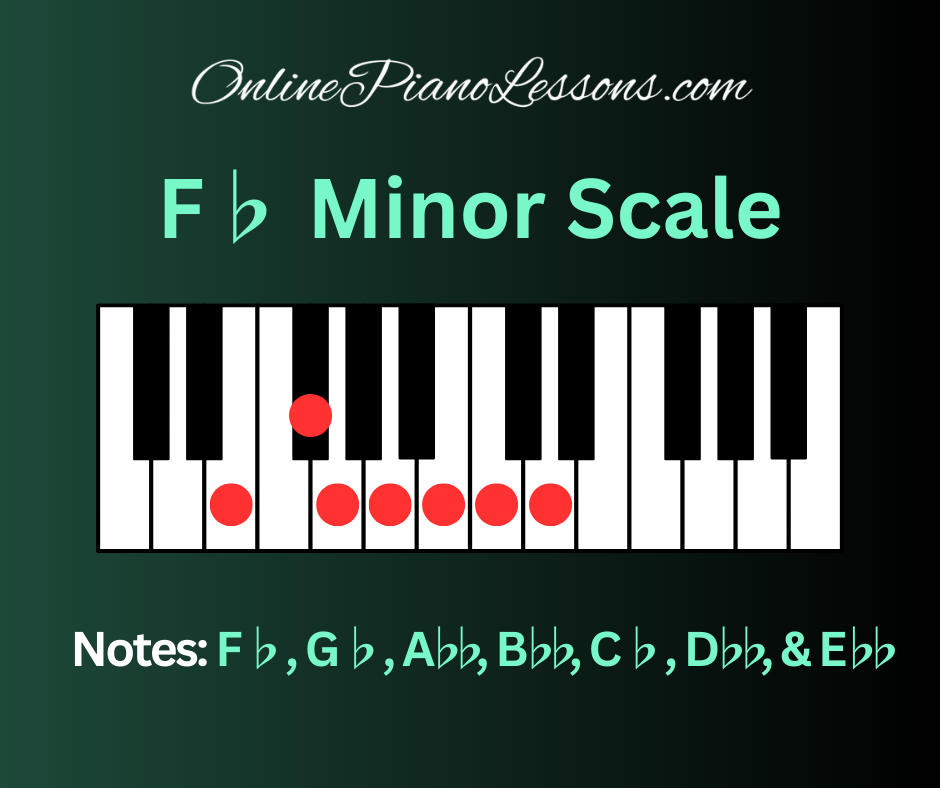
At its core, the F flat minor scale is a natural minor scale whose tonic is F♭. Theoretically the scale would be spelled with flats (and in some degrees double-flats) to preserve the unique letter names for each scale degree. Because F♭ is enharmonically the same pitch as E on a tempered piano, the sounding pitches of the F♭ minor scale are identical to those of the E natural minor scale. In short:
- The F flat minor scale (notation) ≈ the E minor scale (sound and piano keys).
- The F♭ minor scale functions like E minor in performance, but notationally it uses different letter-names.
This enharmonic relationship makes the F♭ minor scale a useful theoretical example while keeping practical piano study simple — play E minor patterns, but understand the flat-based spellings when analyzing the score.
Why Is the F♭ Minor Scale Rare?
There are three practical reasons the F flat minor scale is almost never used by composers or editors:
- Notation Complexity: Writing a passage in F♭ minor requires awkward accidentals (double-flats such as A♭♭ and B♭♭) which slow down reading and increase the chance of mistakes.
- Enharmonic Simplicity: The enharmonic equivalent, E minor, is far easier to read and widely preferred in published piano music.
- Ensemble Practicality: In orchestral and chamber music, parts need clarity. Publishers prefer keys that minimize accidentals for wind and string players.
Despite these reasons, the F flat minor scale is theoretically correct in some modulations and analytical contexts. Knowing it helps you interpret dense harmonic writing and understand why a composer might choose flat-based spellings for voice-leading clarity.
Theoretical Spelling Versus What You Play on Piano
If you insisted on spelling the F flat minor scale exactly, the theoretical notes would include double-flats and unusual accidentals (for example, A♭♭ and B♭♭) so that each degree carries a separate letter name. On the piano, however, those notated pitches map to the simple E minor sounding pitches:
E – F# – G – A – B – C – D – E
So whenever you encounter a theoretical passage labeled F♭ minor, play the corresponding E minor pattern on your piano — your fingers and ears will be correct even though the printed letters might look strange.
Natural, Harmonic, And Melodic Forms (Practical View)
Like all minor keys, the F♭ minor scale has natural, harmonic, and melodic variants in theory. For piano practice, treat these as E minor variants:
- Natural F♭ Minor (sounding as E minor): E – F# – G – A – B – C – D – E.
- Harmonic F♭ Minor (sounding as E harmonic minor): E – F# – G – A – B – C – D# – E (raised 7th).
- Melodic F♭ Minor (ascending, sounding as E melodic minor): E – F# – G – A – B – C# – D# – E (ascending); descending revert to natural minor.
When practicing the F♭ minor scale on piano, use these E minor forms — they are the audible and physical reality, even if theoretical notation differs.
How To Find And Play the F♭ Minor Scale On Piano
Because the F♭ minor scale sounds like E minor, you simply play the E minor scale on the piano. Here’s a practical fingering and step-by-step approach you can use right now.
Right Hand Fingering (One Octave, E minor / F♭ minor):
2 – 3 – 1 – 2 – 3 – 1 – 2 – 3
Left Hand Fingering (One Octave):
3 – 2 – 1 – 3 – 2 – 1 – 3 – 1
Practice two octaves hands separately, then together, slowly with a metronome. Repeat the exercise in the harmonic and melodic variants (raise the 7th and 6th/7th as needed) so your fingers learn the musical shapes of the F♭ minor scale on the piano.
Chords And Harmonic Roles (How F♭ Minor Functions)
When harmonizing or accompanying in the F flat minor scale context, think in E minor chords on piano. The sounding diatonic triads and common sevenths are:
- i — E minor (E–G–B) — theoretical F♭ minor triad.
- ii° — F# diminished (F#–A–C) — theoretical G♭ diminished.
- III — G major (G–B–D) — theoretical A♭♭ major spelling.
- iv — A minor (A–C–E) — theoretical B♭♭ minor.
- v / V — B minor or B major (depending on harmonic minor usage) — theoretical C♭ based chords.
- VI — C major (C–E–G) — theoretical D♭ major.
- VII — D major (D–F#–A) — theoretical E♭ major.
In practice on the piano you’ll voice and play these as E minor–based harmonies. If the score is spelled in F♭ minor, mentally map those chord spellings to the easier E minor equivalents before you play.

What the F♭ Minor Scale Sounds Like
Audibly, the F flat minor scale (played as E minor on piano) has the familiar minor quality: moody, introspective, and capable of dramatic intensity. It’s a versatile minor color used in:
- Nocturnes and lyrical pieces
- Film and cinematic themes for darker moods
- Rock and pop minor-key ballads
- Classical minor-key études and preludes
Because the F♭ minor scale is identical in pitch to E minor, its sonic character is identical — the difference is only in notation and theoretical context, not in what you actually hear when practicing at the piano.
Practice Exercises For The F Flat Minor Scale
Here are focused drills to make the F♭ minor scale fluent on piano (use E minor fingering and pitches):
- Two-Octave Scales: Slow–fast–slow cycles with a metronome. Practice natural, harmonic, melodic forms.
- Arpeggios: E minor arpeggios across two octaves in root position and inversions. Think: F♭ minor arpeggios in theory, E minor on piano.
- Broken Chords: Left-hand ostinato patterns while right hand plays scale fragments.
- Chord Progressions: Loop i–VI–III–VII or i–iv–V (using harmonic minor when appropriate) and practice smooth voice-leading.
- Melodic Etudes: Compose short two-bar phrases using only scale tones and play expressively.
Daily, focused practice of 10–20 minutes on these tasks makes the F flat minor scale performance-ready on piano.
When You Might Encounter F♭ Minor In Scores
Although rare, the F flat minor scale can appear in:
- Analytical examples in theory texts where letter naming matters.
- Editorial or orchestral scores that preserve flat-based harmonic relationships.
- Highly chromatic or enharmonically spelled works where a composer intentionally uses flat spellings for voice-leading clarity.
When you see F♭ minor on the page, translate it to E minor for playing, but keep the theoretical spelling in mind when discussing harmony or analysis.
FAQ
Is the F flat minor scale the same as E minor on piano?
Yes — on a tempered piano the F♭ minor scale sounds identical to E minor. The difference is notational and theoretical.
Why would anyone write music in F♭ minor?
For harmonic consistency and correct letter-name spelling in flat-based modulations or analytical examples.
How should I practice the F♭ minor scale on piano?
Practice it as E minor — use standard E minor fingerings and practice natural, harmonic, and melodic variants.
Does learning the F flat minor scale help my piano playing?
Absolutely. Studying the F♭ minor scale deepens your understanding of enharmonic relationships, improves sight-reading for odd spellings, and solidifies minor-key technique on piano.
Are there famous pieces in F♭ minor?
Very few (practically none) are printed in F♭ minor; composers almost always prefer E minor notation. Theoretical contexts are where you’ll most often see F♭ minor scale references.

 Hi, I'm Thomas, Pianist Composer,
  I love playing piano, creating new melodies and songs, and further developing my online piano course and making updates/additions to my site OnlinePianoLessons.com!
  Now that is what I call fun!