

The E flat minor scale is a dark, richly colored minor key that gives pianists a powerful expressive palette. Whether you’re analyzing Romantic repertoire, composing film music, or building technique on the keyboard, the E flat minor scale (written here as both E flat minor scale and E♭ minor scale) is a useful and evocative tool. This guide explains what the E flat minor scale is, how to find and play the E♭ minor scale on the piano, how the scale functions harmonically, practical fingerings and exercises, common repertoire, and everyday tips to master this key.
Throughout this article I’ll use both names—E flat minor scale and E♭ minor scale—so you can recognize either notation in scores and conversation. I’ll also continually relate the theory to the piano so everything you read is directly transferable to your practice.

What Is The E Flat Minor Scale?
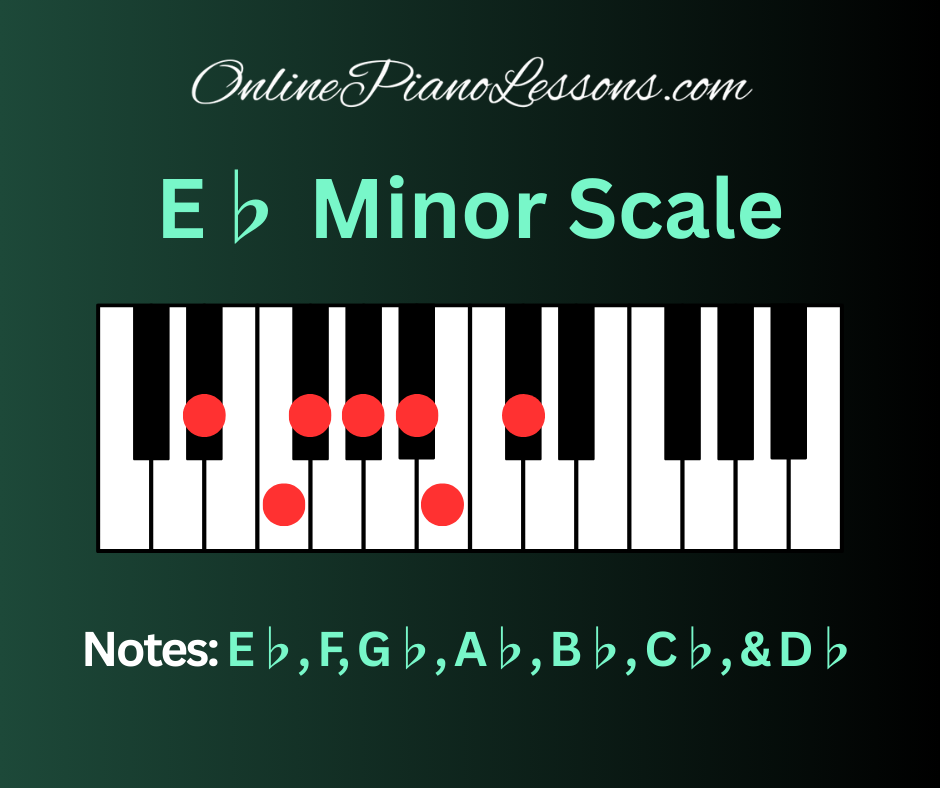
The E flat minor scale is the natural minor scale that begins on E♭. In its natural form the E flat minor scale contains the notes:
E♭ – F – G♭ – A♭ – B♭ – C♭ – D♭ – E♭
Notationally, the E♭ minor scale has six flats in its key signature: B♭, E♭, A♭, D♭, G♭, and C♭. That heavy flat signature gives the E flat minor scale its distinct, somber timbre on the piano. When you play the E♭ minor scale, you’ll notice the mixture of black and white keys creates a particular hand shape and color that many pianists find compelling.
Remember: whenever you see E flat minor scale or E♭ minor scale printed, the same pitches and the same expressive character are implied.
Natural, Harmonic, And Melodic Forms
Like every minor key, the E flat minor scale has three forms you’ll encounter in music and in practice:
- Natural E♭ Minor Scale (Aeolian): E♭ – F – G♭ – A♭ – B♭ – C♭ – D♭ – E♭. This is the pure minor sound and the foundation of the E flat minor scale.
- Harmonic E♭ Minor Scale: E♭ – F – G♭ – A♭ – B♭ – C♭ – D♮ – E♭. The raised seventh (D♭ → D♮ in sounding terms) creates a stronger leading tone to E♭ and is essential for classical cadences and functional harmony built from the E flat minor scale.
- Melodic E♭ Minor Scale:
-
-
Ascending: E♭ – F – G♭ – A♭ – B♭ – C♮ – D♮ – E♭ (raised 6th and 7th).
-
Descending: E♭ – D♭ – C♭ – B♭ – A♭ – G♭ – F – E♭ (usually reverts to natural minor).
-
When practicing the E flat minor scale on piano, practice all three forms so your ear and technique are ready for any musical context.
How To Find The E Flat Minor Scale On The Piano
To play the E flat minor scale on the piano, start by locating the tonic: E♭ is the black key immediately to the left of E natural. From that point follow the scale intervals (whole–half–whole–whole–half–whole–whole) using the correct accidentals for the version you need—natural, harmonic, or melodic.
Physically, the pattern of black and white keys for the E flat minor scale gives the left hand and right hand distinct ergonomic shapes on the piano. Because the E♭ minor scale uses many black-key neighbors (G♭, A♭, B♭), practicing E flat minor scale arpeggios and scale runs will improve your black-key facility and thumb crossings.
Fingering Recommendations
Good fingering makes scale practice efficient and relaxed. Below are suggested fingerings for one octave of the E♭ minor scale on piano. Adjust for hand size and comfort, but keep fingering consistent.
Right hand (ascending, natural/melodic/harmonic as needed):
2 (E♭) – 3 (F) – 1 (G♭) – 2 (A♭) – 3 (B♭) – 1 (C♭) – 2 (D♭) – 3 (E♭)
Left hand (ascending):
3 (E♭) – 2 (F) – 1 (G♭) – 3 (A♭) – 2 (B♭) – 1 (C♭) – 3 (D♭) – 1 (E♭)
For two-octave practice, repeat the pattern with standard thumb-under technique. When bringing the E flat minor scale to speed, prioritize relaxed wrists and even tone more than tempo.
Arpeggios and Chords From The E Flat Minor Scale
To harmonize melodies and accompany singers or instrumentalists, it helps to know the basic triads and seventh chords derived from the E flat minor scale. The diatonic triads (natural form) are:
- i — E♭ minor: E♭–G♭–B♭
- ii° — F diminished: F–A♭–C♭
- III — G♭ major: G♭–B♭–D♭
- iv — A♭ minor: A♭–C♭–E♭
- v — B♭ minor: B♭–D♭–F
- VI — C♭ major: C♭–E♭–G♭
- VII — D♭ major: D♭–F–A♭
In the harmonic E flat minor scale the v chord often becomes major (B♭ major) or dominant seventh (B♭7) to create strong resolutions back to E♭—a standard classical device when working with the E flat minor scale on piano.
Practicing arpeggios for E flat minor scale triads and sevenths across octaves dramatically improves your left-hand accompaniment and voicing choices on the piano.
Character And Musical Uses
The E flat minor scale carries a notably somber and searching color. Classical composers use the E♭ minor scale for introspective slow movements, stormy interludes, and moments of deep feeling. In film scoring the E flat minor scale is a go-to for melancholy themes and tense, shadowy textures. Jazz players sometimes use the E♭ minor scale (or its melodic form) for modal improvisation and for connecting between flat-key tonalities.
On the piano, passages in the E flat minor scale often sit well in the lower-middle register where the scale’s dark sonority can resonate. The black-key emphasis in the E♭ minor scale helps shape legato phrasing and dense chord voicings.

Practice Routine For Mastery
Here is a practical routine to make the E flat minor scale feel fluent on piano:
- Scale Warmup (5–7 minutes): Play two-octave E♭ minor scale hands separately, slow to medium tempo. Alternate natural, harmonic, melodic.
- Arpeggio Drill (5 minutes): Two-octave arpeggios for E♭ minor triads and E♭ minor seventh chords. Practice inversions.
- Progressions (5 minutes): Loop i–VI–III–VII (E♭m–C♭–G♭–D♭) and i–iv–V (with V major from harmonic minor) to internalize harmonic function on piano.
- Etude or Excerpt (5–10 minutes): Sight-read or slowly learn a musical excerpt in the E♭ minor scale to apply technique musically.
- Improvisation (5 minutes): Improvise a short theme using E♭ minor scale tones, experimenting with melodic minor colors ascending.
Daily repetition of this routine—short, focused, and musical—will make the E flat minor scale technically secure and expressively meaningful on the piano.
Common Pitfalls And How To Avoid Them
- Tense Hands: The black-key emphasis in the E flat minor scale can invite gripping—stay relaxed.
- Inconsistent Fingering: Stick to one fingering pattern for scales and arpeggios to build muscle memory.
- Overuse of Pedal: Heavy pedaling blurs the dense E♭ minor sonority—change pedal cleanly and listen.
- Forgetting Modal Variants: Label practice sections clearly when switching between natural, harmonic, and melodic E flat minor scale forms so you don’t accidentally play the wrong raised degrees.
Addressing these issues early keeps your E flat minor scale practice efficient and musical.
Repertoire Examples
While full pieces in E♭ minor are less common than in some other keys, several important works and passages exploit the E♭ minor scale’s mood:
- Romantic miniatures and nocturnes that use flat-rich harmonies.
- Dramatic film cues that build tension in the E♭ minor scale.
- Jazz ballads that modulate through flat minor regions.
Learning short excerpts in E♭ minor scale-based music is one of the fastest ways to internalize its harmonic and melodic habits on the piano.
FAQ
How many flats are in the E♭ minor scale key signature?
The natural E flat minor scale key signature contains six flats: B♭, E♭, A♭, D♭, G♭, and C♭.
Is E♭ minor the same as D♯ minor?
They are enharmonic equivalents—E♭ minor and D♯ minor sound the same on the piano but are spelled differently. Music is often written in one or the other depending on context.
Which chords come from the E flat minor scale?
The basic triads from the E♭ minor scale include E♭ minor, F diminished, G♭ major, A♭ minor, B♭ minor, C♭ major, and D♭ major.
Should I practice E♭ minor scale in all three forms?
Yes—natural, harmonic, and melodic forms of the E flat minor scale all appear in repertoire and teach different technical and musical skills.
Is E♭ minor hard to play on piano?
It has many flats, but pianists who practice it regularly find it comfortable; the black-key relationships help shape efficient hand positions.

 Hi, I'm Thomas, Pianist Composer,
  I love playing piano, creating new melodies and songs, and further developing my online piano course and making updates/additions to my site OnlinePianoLessons.com!
  Now that is what I call fun!