

Different Music Notes Chart
Learning to read music is a lot like learning a new language. When you first look at a sheet of music, it might look like a chaotic scramble of lines, dots, and squiggles. However, once you understand the logic behind the symbols, that chaos turns into a roadmap. For aspiring musicians, understanding the different music notes is the absolute foundation of music theory and performance.
Whether you are just starting to learn the piano or you are picking up a different instrument, rhythm is king. While the placement of a note on the staff tells you what pitch to play (A, B, C, etc.), the shape of the note tells you how long to play it. Without understanding the duration of these symbols, a melody is just a random string of sounds.
In this guide, we will break down the anatomy of a note, explore the standard hierarchy of rhythms, look at the importance of silence (rests), and dive into how these concepts apply specifically to the piano.
The Anatomy Of A Music Note
Before we memorize the time values, we need to understand what makes up the physical symbol. Recognizing these components helps you identify different music notes quickly while sight-reading.
There are three main parts to a note:
- The Note Head: This is the oval part of the note. It can be open (hollow) or closed (filled in). The note head sits on a specific line or space on the staff to indicate pitch.
- The Stem: This is the vertical line attached to the note head. Depending on how high or low the note is on the staff, the stem may point up or down. If the stem points up, it attaches to the right side of the note head. If it points down, it attaches to the left.
- The Flag (or Beam): This is the curved stroke attached to the end of the stem. Flags are always on the right side of the stem. When multiple notes with flags are next to each other, they are often connected by a thick bar called a “beam” to make the music easier to read.
The Most Common Music Notes
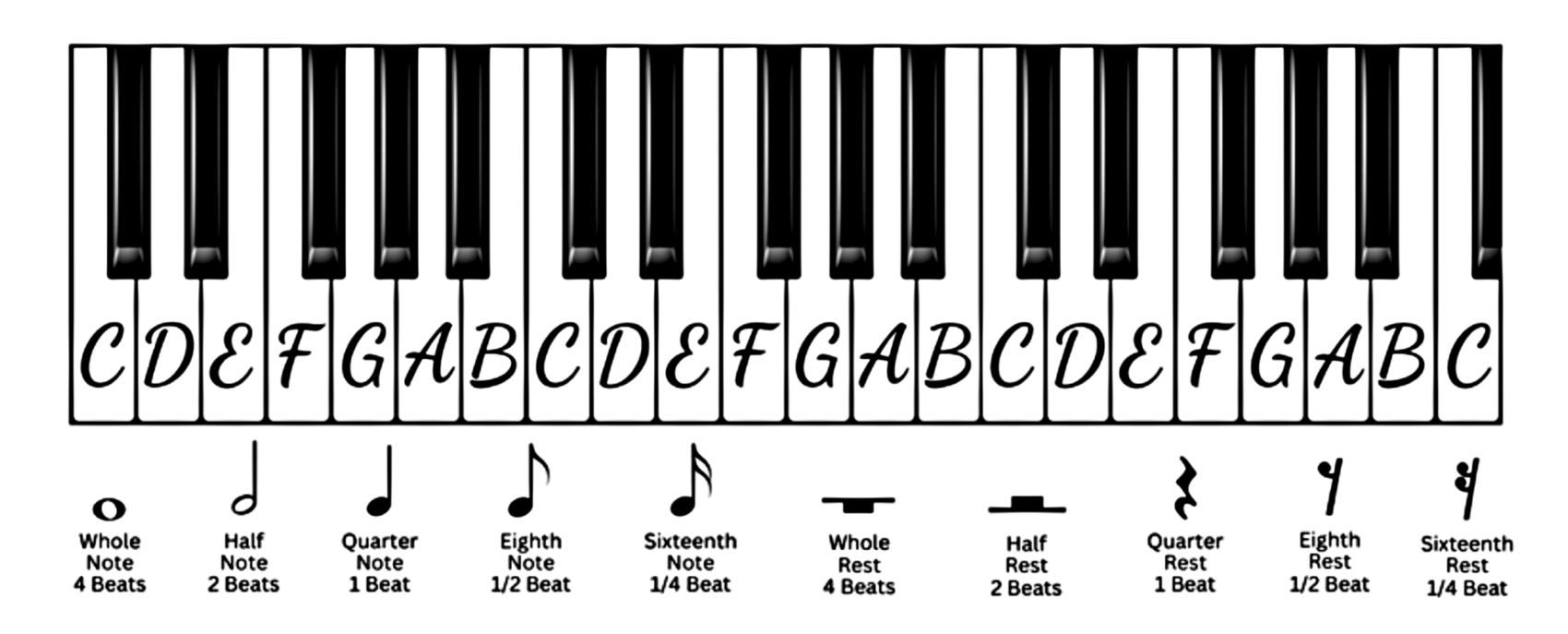
In standard 4/4 time (which is the most common time signature you will encounter on the piano), the beat is usually counted as “1, 2, 3, 4.” The type of note tells you how many of those beats to hold a key down.
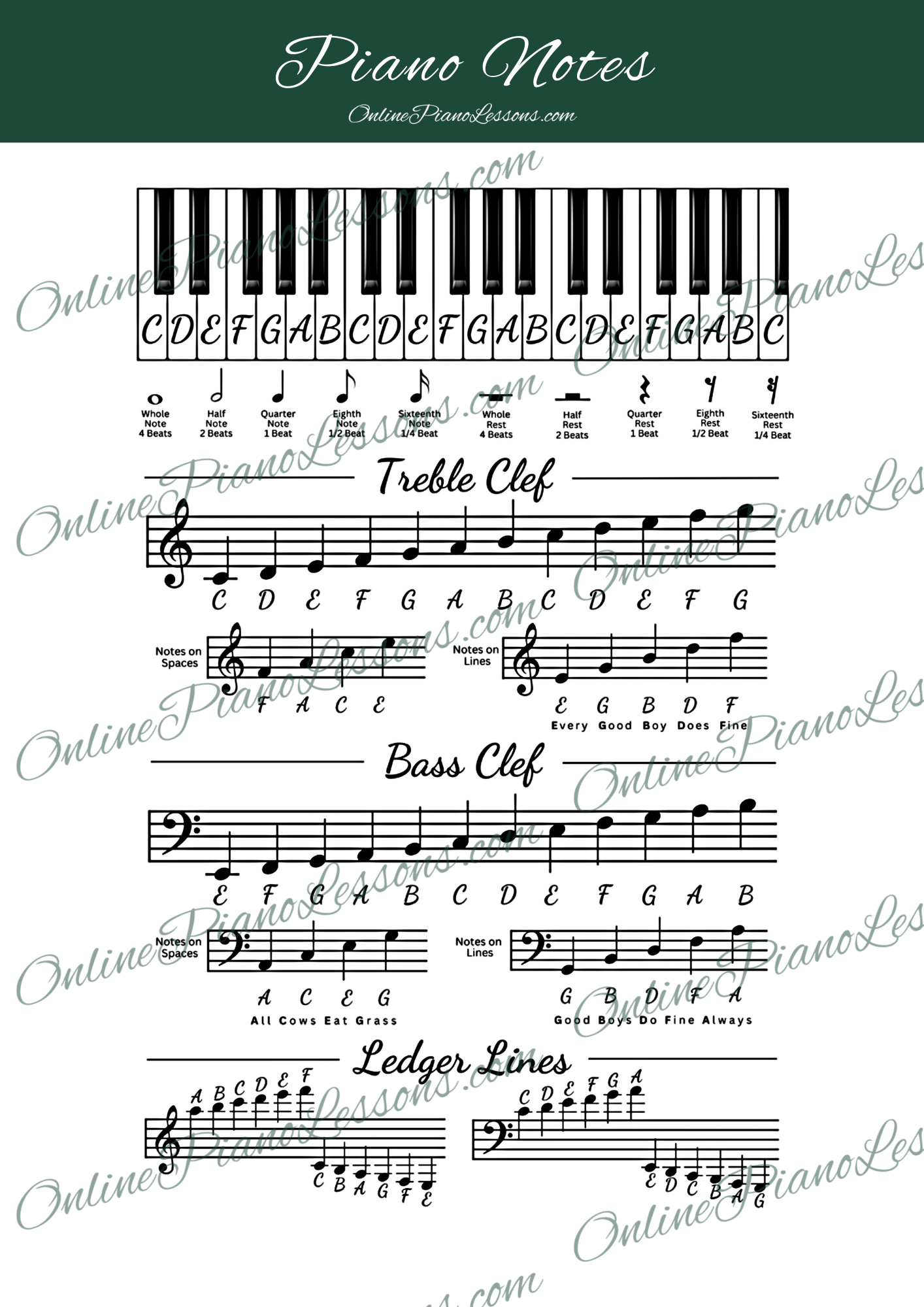
The Whole Note (Semibreve)
The whole note is the longest note value commonly found in modern music. Visually, it looks like a hollow oval with no stem.
In 4/4 time, a whole note lasts for four beats. When you are playing the piano, you would strike the key on count “1” and hold it down through “2, 3, and 4.” It takes up an entire measure of music. Beginners often rush whole notes, so it is vital to count them out fully in your head to maintain the tempo.
The Half Note (Minim)
If you take a whole note and cut it in half, you get the half note. It looks like a hollow note head, but unlike the whole note, it has a stem attached to it.
A half note lasts for two beats. In a single measure of 4/4 time, you can fit two half notes. You would play the first one on beat “1” (holding for beat 2) and the second one on beat “3” (holding for beat 4). Learning to transition smoothly between half notes is a great exercise for developing legato on the piano.
The Quarter Note (Crotchet)
This is the most recognizable symbol in music. The quarter note features a filled-in (solid) note head with a stem.
As the name implies, it is a quarter of the value of a whole note. This means it lasts for one beat. In 4/4 time, there are four quarter notes in a measure. This is often the steady pulse you tap your foot to when listening to the radio. When learning different music notes, the quarter note is usually the “baseline” or the standard unit of beat that students learn first.
The Eighth Note (Quaver)
Now we start getting faster. The eighth note looks like a quarter note (solid head with a stem), but it adds a flag to the stem. If there are two eighth notes next to each other, they are usually connected by a single beam.
An eighth note lasts for half of a beat. This means you can fit two eighth notes into the time it takes to play one quarter note. When counting rhythm on the piano, you often count these as “1-and, 2-and, 3-and, 4-and.”
The Sixteenth Note (Semiquaver)
To play even faster, we look to the sixteenth note. This symbol looks like an eighth note but has two flags or two beams connecting the stems.
A sixteenth note lasts for a quarter of a beat. You fit four of these notes into one single quarter note beat. Musicians often count these as “1-e-and-a, 2-e-and-a.” Playing sixteenth notes cleanly requires excellent finger dexterity on the piano.
The Sound Of Silence: Rest Symbols
Music isn’t just about sound; it is also about silence. In music theory, periods of silence are marked by symbols called “rests.” For every note value, there is a corresponding rest that shares the same duration. Mastering different music notes also requires mastering their silent counterparts.
- Whole Rest: This looks like a small rectangle hanging below the fourth line of the staff. It indicates silence for four beats (a full measure). A good trick to remember this is that it looks like a “hole” in the ground.
- Half Rest: This looks similar to the whole rest, but the rectangle sits on top of the third line. It looks like a hat. It indicates silence for two beats.
- Quarter Rest: This is a squiggly line that looks somewhat like a sideways bird or a lightning bolt. It indicates one beat of silence.
- Eighth Rest: This looks like a number “7” with a small bulb on the tip. It indicates a half-beat of silence.
- Sixteenth Rest: This looks like the eighth rest but has two bulbs/flags. It represents a quarter-beat of silence.
When you see these rests while playing the piano, you must lift your fingers off the keys. The silence should be just as precise as the notes you play.
Advanced Rhythms And Modifications
Once you have mastered the basics, you will encounter variations that change the duration of the standard notes.
Dotted Notes
You will frequently see a small dot placed to the immediate right of a note head. This is called a dotted note. The dot adds half of the note’s original value to its duration.
For example, a standard half note is 2 beats. Half of 2 is 1. Therefore, a dotted half note is 2 + 1 = 3 beats. This is extremely common in waltz music, which is written in 3/4 time. Understanding dotted rhythms is essential for adding swing and flow to your piano repertoire.
Ties
A tie is a curved line that connects two notes of the same pitch. When you see a tie, you add the values of the two notes together and play them as one unbroken sound. For instance, if a quarter note is tied to a half note, you hold that key for 3 beats total (1 + 2). This allows composers to extend sound across bar lines, creating syncopation and interesting rhythms among different music notes.
Tuplets And Triplets
Sometimes, composers want to break the rules of binary division (dividing by 2). The most common way to do this is with a triplet. A triplet groups three notes into the space usually occupied by two.
For example, a “quarter note triplet” usually squeezes three quarter notes into the space of a half note. Eighth note triplets squeeze three eighth notes into the space of one quarter note. This creates a rolling, flowing feel that is distinct from the marching “1-and-2-and” feel of standard eighth notes.
Practical Application For Piano Players
Why is it so important to memorize these symbols? Because the piano is a percussion instrument. Unlike a violin or a human voice, the sound of a piano naturally decays the moment you strike the key. To create a singing melody, a pianist must hold the keys down for their exact, full value.
If you treat a half note like a quarter note, the music will sound choppy and disconnected. Furthermore, piano music is unique because you are reading two staves at once (treble clef and bass clef). You might be playing long, sustained whole notes in your left hand while your right hand is playing rapid sixteenth notes.
Understanding how different music notes line up vertically on the page is the secret to hand coordination. You learn to see that for every one note in the left hand, you need to fit four notes in the right hand. This mathematical understanding helps your brain coordinate your fingers.
Conclusion
Mastering music notation does not happen overnight. It takes time to look at a page and instantly recognize the values without having to mentally count “1-e-and-a.” However, by familiarizing yourself with these different music notes, rests, and modifiers, you are building the vocabulary you need to express yourself musically.
Start by clapping rhythms before you try to play them on the piano. If you can feel the rhythm in your body, it will easily transfer to your fingertips. Remember, the notes on the page are just instructions; it is up to you to bring them to life.
FAQ
What is the fastest music note?
While the sixteenth note is fast, there are even faster notes! You might encounter Thirty-Second notes (three flags) or even Sixty-Fourth notes (four flags). These are very short and are used in virtuoso pieces.
Why are the stems on some notes pointing down?
This is purely for visual cleanliness. If a note is on the middle line of the staff or higher, the stem goes down (on the left). If it is below the middle line, the stem goes up (on the right). This keeps the stems inside the staff so the music doesn’t look cluttered.
Do different music notes sound different in pitch?
No, the shape of the note (whole, quarter, eighth) only dictates the duration (time). The pitch (how high or low the sound is) is determined by where the note sits vertically on the staff lines.
How do I practice reading rhythm for piano?
Try “tapping” exercises. Put your metronome on a slow beat. Tap your left hand for whole notes (1 beat every 4 clicks) and your right hand for quarter notes (1 tap every click). This helps separate your hands’ rhythmic independence.
What is a beam?
A beam is the thick horizontal line connecting the stems of eighth notes or sixteenth notes. It replaces the flags. It groups the notes together visually so you can see where the beats fall, making it much easier to read than a page full of individual flags.

 Hi, I'm Thomas, Pianist Composer,
  I love playing piano, creating new melodies and songs, and further developing my online piano course and making updates/additions to my site OnlinePianoLessons.com!
  Now that is what I call fun!