 Get Full Access (Only $5/mo)

Learning how to play an A major chord and understanding all variations of A major chords on the piano is an essential step for any musician who wants to build confidence in music theory, harmony, and real-world piano playing. The key of A major is bright, optimistic, and widely used across classical, pop, rock, gospel, and contemporary worship music.
Because of its uplifting quality and familiar sound, the A major chord is one of the first shapes many pianists learn. In this definitive guide, we will explore the structure of A major chords, how they function within the key of A, how to play them on the piano, what they sound like, and how they appear in real-world music.

By the end of this guide, you will understand how every version of the A major chord works, how to move between A major chords smoothly, and how to use these harmonies creatively in your own piano playing.
What Is An A Major Chord?
On the piano, an A major chord is built using three notes: A, C#, and E. These three notes come from the A major scale and form what musicians call a triad. A triad is the simplest version of a chord, and in this case, the A major chord is formed by taking:
- The root: A
- The major third: C#
- The perfect fifth: E
When you play these three notes together, you get the full, bright, uplifting sound associated with A major chords on the piano.
The reason this chord sounds “major” is because of the interval between the root (A) and the third (C#). A major third interval has a warm, open quality. On the piano, you’ll hear the brightness of the A major chord the moment you strike all three notes at once.
Understanding The A Major Scale
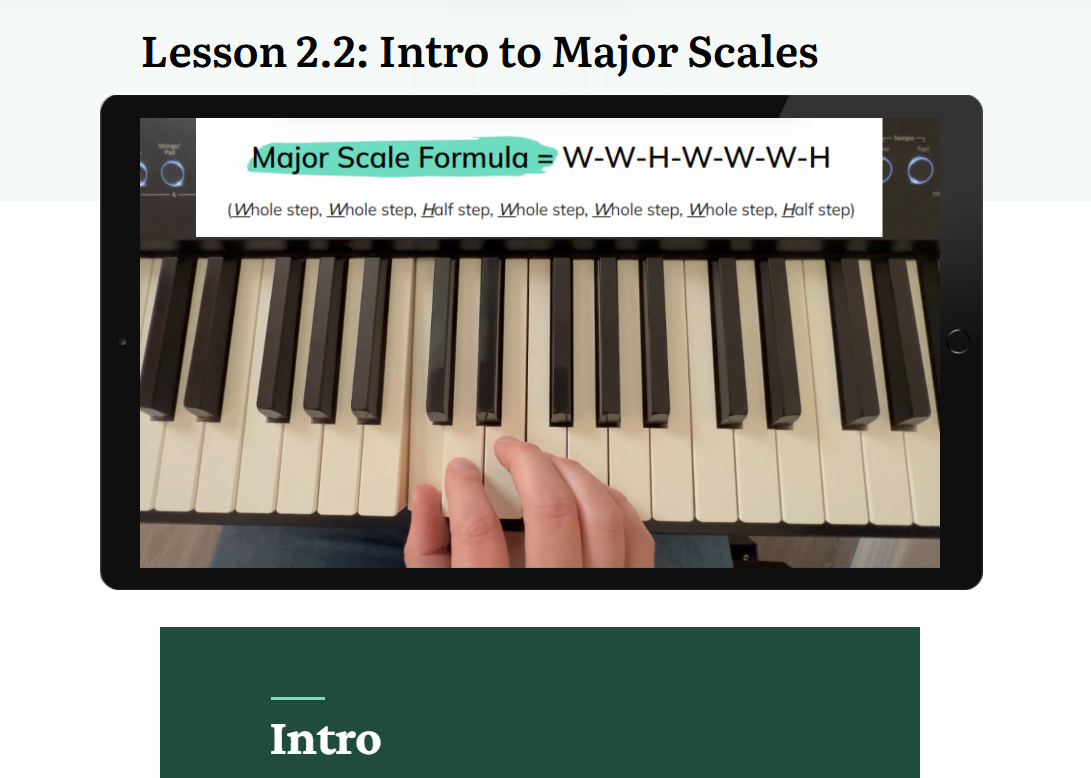
To fully understand A major chords, it helps to look at the A major scale. The scale follows the pattern of whole steps and half steps used for all major scales:
A – B – C# – D – E – F# – G# – A
From this scale come all the notes used to build A major chords on the piano. Specifically:
- 1st note → A
- 3rd note → C#
- 5th note → E
Because these scale degrees form the core of Western harmony, the A major chord serves as the “home base” whenever you are playing in the key of A major.
How To Play A Major Chords On The Piano
There are multiple ways to play A major chords on the piano, and learning each version will expand your versatility, comfort, and creativity.
1. Root Position (A – C# – E)
This is the most common voicing of the A major chord. Your thumb (1) plays A, your middle finger (3) plays C#, and your pinky (5) plays E. On the piano, this shape feels natural and is easy to shift up or down to form other major chords.
2. First Inversion (C# – E – A)
In this inversion, the C# becomes the lowest note. This version of the A major chord sounds slightly softer and less final than root position. On the piano, first inversion is essential for smoother chord transitions, especially when moving from A major to D major or F# minor.
3. Second Inversion (E – A – C#)
Here, E is the lowest note. Second inversion A major chords are stable and often used in pop and worship music because they create a wide, open sound. On the piano, second inversion is also easier when playing quick progressions such as A–E–F#m–D.
How A Major Chords Sound On The Piano
The sound of an A major chord on the piano can be described as:
- Bright
- Warm
- Uplifting
- Full
- Open
- Optimistic
Because of the major third interval (A to C#), the A major chord avoids the darker, heavier feeling of minor chords. This is why A major chords appear in many emotional, hopeful, and energetic pieces across genres.
Listen to famous songs in A major, and you’ll immediately hear how commonly the A major chord appears in intros, choruses, and resolutions.
Chords Built From The A Major Scale
If you want to go deeper with A major chords on the piano, it’s helpful to understand the entire chord family of the key of A major. Each chord is built on a different note of the A major scale:
- A major (A – C# – E)
- B minor (B – D – F#)
- C# minor (C# – E – G#)
- D major (D – F# – A)
- E major (E – G# – B)
- F# minor (F# – A – C#)
- G# diminished (G# – B – D)
Within this family, the A major chord is the I chord—the tonal center. Many chord progressions revolve around it. If you are playing on the piano, knowing these related chords makes it easier to improvise, write music, or understand how songs are structured.
For example, these common progressions highlight A major chords:
- A – D – E (I – IV – V)
- A – F#m – D – E
- A – C#m – F#m – D
- A – E – F#m – C#m
Each one uses the A major chord as the anchor.
Popular Songs That Use A Major Chords
Because the A major chord is so versatile, you’ll hear it across every genre on the piano:
- Pop ballads
- Rock anthems
- Worship and gospel
- Country
- EDM
- Classical piano works
- Movie soundtracks
Songs in A major often use simple yet powerful progressions that revolve around the A major chord. Even for beginners, this makes playing songs in A major very accessible.
How To Practice A Major Chords Effectively
To master A major chords on the piano, try the following practice techniques:
1. Practice Each Inversion
Switch between root position, first inversion, and second inversion smoothly. This builds muscle memory and hand familiarity.
2. Use A Metronome
Playing A major chords at slow and steady tempos helps you learn rhythmically and avoid rushing.
3. Play Progressions Using A Major
Try cycles like:
- A → D → E
- A → C#m → F#m → D
- A → E → F#m → C#m
This makes chord transitions smoother and helps you understand the musical context of the A major chord.
4. Arpeggiate The Chord
Play each note individually (A, C#, E). This improves accuracy and develops right-hand and left-hand independence on the piano.

5. Explore Different Rhythms
Try holding the A major chord for whole notes, half notes, quarter notes, and syncopated patterns.
The Emotional Character Of A Major
Musicians often describe A major as:
- Heroic
- Hopeful
- Confident
- Strong
Composers like Beethoven, Chopin, and Mozart frequently used A major for expressive, uplifting sections of their works. On the piano, the A major chord captures a feeling of clarity and brightness that resonates well with listeners.
Left-Hand A Major Chords
On the piano, the left hand typically plays lower voicings of the A major chord to provide bass support. Common left-hand versions include:
- A + E (root + fifth)
- A + C# + E (root position triad)
- E + A (fifth + root) for lighter textures
Playing A major chords in the left hand while improvising with the right hand creates a balanced, full sound.
Right-Hand A Major Chords
The right hand often plays higher, brighter versions of the A major chord. These voicings cut through and complement the left hand beautifully. Because the piano naturally emphasizes higher frequencies, right-hand A major chords are especially expressive.
Extended And Advanced A Major Chords
As you grow more advanced on the piano, you can explore extended versions of A major chords, such as:
- A major 7 (A – C# – E – G#)
- A dominant 7 (A – C# – E – G)
- A add9 (A – C# – E – B)
- A6 (A – C# – E – F#)
- A major 9 (A – C# – E – G# – B)
These chords add color, emotion, and richness to your piano playing.
FAQ
What notes make up an A major chord?
An A major chord is made of A, C#, and E.
How do I play A major chords on the piano?
Start with A–C#–E in root position, then learn first and second inversion.
Are A major chords hard to learn?
Not at all. They are among the simplest and most common chords on the piano.
What is the emotional character of the A major chord?
It sounds bright, warm, and uplifting.
What songs use A major chords?
Hundreds of popular, classical, worship, and rock songs use the A major chord prominently.


 I love playing piano, creating new melodies and songs, and further developing my online piano course and making updates/additions to my site OnlinePianoLessons.com!
  Now that is what I call fun!