

Piano Diagram Chart
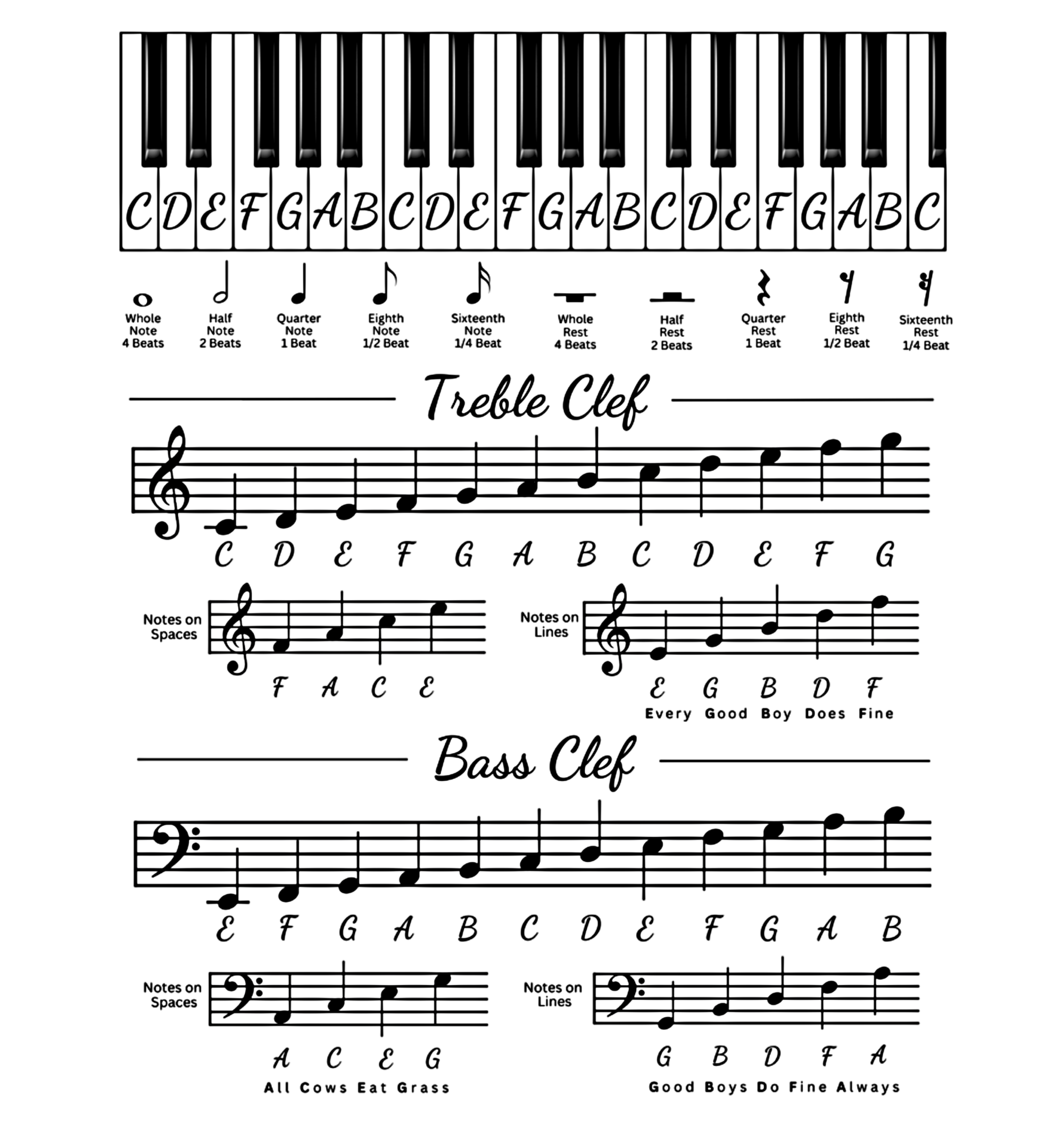
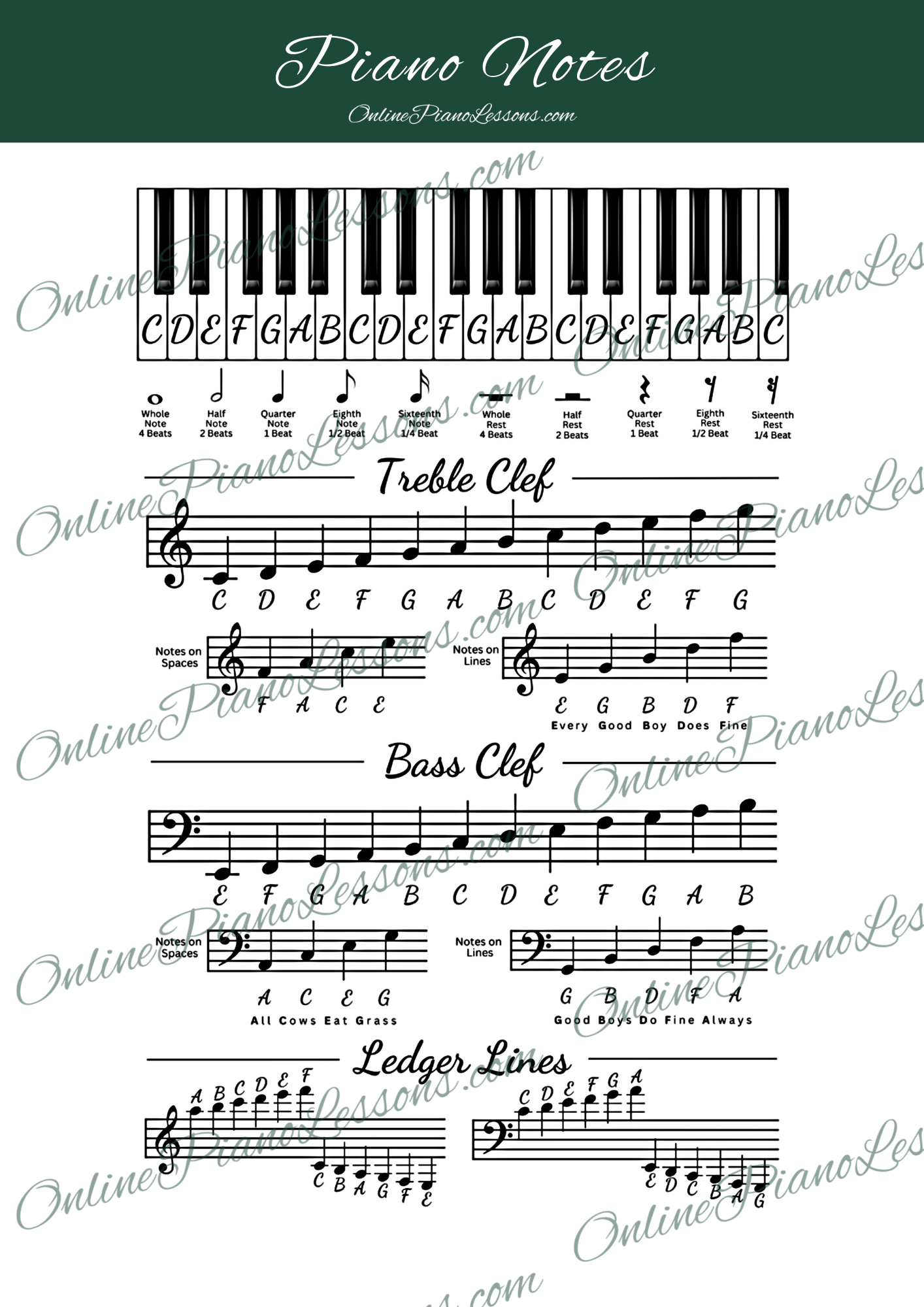
A Piano Diagram or Piano Chart is one of the most helpful learning tools for beginners and even intermediate players who want a clearer, more visual understanding of how the piano works. The chart above includes several essential elements: labeled keys, note values, the treble clef, the bass clef, and memory aids for reading sheet music.
In this guide, we’ll walk through every section of the Piano Diagram so you understand what each part means and how to use it to improve your piano playing. By the end, you’ll have a deeper grasp of the layout of the keyboard, how sheet music aligns with the keys, and how rhythm and notation work together—making you a more confident and capable musician.
Understanding The Piano Keyboard Layout
The top portion of the Piano Diagram shows a detailed view of the piano keyboard with all white keys labeled. This is the foundation of the entire Piano Chart because it visually connects musical notes to physical keys. The layout repeats alphabetically: C, D, E, F, G, A, B, and then it returns again to C. This repeating pattern is the structure of all Western music, and understanding it helps you quickly navigate the piano.
The Piano Diagram makes it simple to memorize the repeating blocks of keys. The black keys appear in groups of two and three across the keyboard; these help you identify the white keys. For example, C is always the white key directly to the left of a group of two black keys. F is the white key to the left of a group of three black keys. With this knowledge, you can locate any note instantly—even on a full 88-key piano.
Using this section of the Piano Chart, beginners can start establishing spatial memory. Knowing where notes are without needing to count keys every time is one of the biggest steps toward playing smoothly and confidently.
Note Values And Rhythm Essentials
Below the keyboard in the Piano Diagram, you’ll find icons for note values: whole notes, half notes, quarter notes, eighth notes, and sixteenth notes. Each symbol is paired with its rhythmic duration. This part of the Piano Chart gives a clear overview of how long a note should be held during performance.
Here’s a quick breakdown based on the Piano Diagram:
- Whole Note = 4 beats
- Half Note = 2 beats
- Quarter Note = 1 beat
- Eighth Note = ½ beat
- Sixteenth Note = ¼ beat
These rhythms apply to rests as well, and the Piano Chart conveniently shows their symbols too. Rhythm is just as important as pitch, and having these visual reminders helps reinforce rhythmic awareness while sight-reading.
Understanding note values from the Piano Diagram improves your timing, strengthens your internal sense of pulse, and makes reading sheet music significantly easier. Many students struggle more with rhythm than with knowing which keys to play, so this chart section is essential.
Treble Clef: Notes On The Staff
The next major component of the Piano Diagram focuses on the treble clef, the upper staff typically played with the right hand. The Piano Chart includes a sample musical passage with labeled notes, allowing you to connect the written notes directly to their letter names.
Below the staff, the Piano Diagram provides two very helpful mnemonic devices:
- Notes on Spaces: F – A – C – E (“FACE”)
- Notes on Lines: E – G – B – D – F (“Every Good Boy Does Fine”)
These are traditional memory aids for reading treble clef notation. When you look at the Piano Chart while playing, you can quickly recall which notes belong on which line or space. This strengthens your sight-reading ability and speeds up recognition of common patterns in sheet music.
Additionally, seeing how these notes move upward across the staff while comparing it to the keyboard layout gives you a complete visual map of pitch direction. Higher notes on the staff move to the right on the keyboard; lower notes move to the left. This simple connection is a core concept that the Piano Diagram communicates perfectly.
Bass Clef: Notes For The Left Hand
The bass clef portion of the Piano Diagram mirrors the treble clef section but focuses on the left hand. Many beginners struggle with the bass clef because it uses different note placements and mnemonics. The Piano Chart simplifies this.
The Piano Diagram includes:
- Notes on Spaces: A – C – E – G (“All Cows Eat Grass”)
- Notes on Lines: G – B – D – F – A (“Good Boys Do Fine Always”)
These memorable phrases make learning the bass clef much easier. When combined with the keyboard labels at the top of the Piano Chart, you begin to understand how the left-hand notes relate to the lower half of the piano.
Beginners often focus heavily on the treble clef, but the bass clef is just as important. The Piano Diagram encourages balanced learning by showing both clefs together, helping you understand the grand staff and how both hands coordinate when reading music.
How The Piano Diagram Helps You Learn Faster
A good Piano Diagram or Piano Chart is more than just a reference tool—it’s a learning accelerator. Here’s how using the Piano Diagram regularly can strengthen your skills:
1. Visualizing Keyboard Geography
The keyboard layout section of the Piano Diagram helps your brain map where notes belong. Seeing the pattern repeatedly trains your muscle memory and reduces hesitation while playing.
2. Strengthening Sight-Reading
By combining the treble clef, bass clef, and keyboard layout, the Piano Chart builds the mental bridge between written music and physical piano keys.
3. Improving Rhythm And Timing
The note value section reinforces rhythmic comprehension. Even glancing at this portion of the Piano Diagram during practice improves your timing and consistency.
4. Building Confident Hand Independence
Because the Piano Diagram shows both clefs, it helps you understand how the hands interact. Recognizing patterns between the two staves is crucial for reading more complex music.
5. Providing A Quick-Reference Guide
A Piano Chart is perfect for students who want instant clarification while practicing. It reduces confusion and boosts learning efficiency.
Using The Piano Diagram During Practice Sessions
To get the most benefit from your Piano Diagram, try the following practice tips:
- Keep it visible while playing so you can refer to it quickly.
- Match written notes to keys on the diagram before playing them.
- Practice identifying notes on the staff using the memory aids provided.
- Tap rhythms based on the note values on the Piano Chart.
- Say the letter names aloud while looking at the keyboard portion to reinforce mapping.
Over time, this consistent reinforcement builds automatic recognition—one of the most valuable skills for any pianist.
History And Importance Of Piano Charts
Long before digital apps and interactive music theory tools, musicians used paper-based charts like this Piano Diagram to learn the fundamentals of music. Teachers relied on Piano Chart materials to introduce students to note-reading, rhythms, and basic keyboard familiarity.
Even today, despite technological advancements, the traditional Piano Diagram remains one of the most effective learning aids because it presents all the essentials in one place. Visual learners especially benefit, as the Piano Chart connects abstract musical concepts with physical, concrete imagery.
FAQ
What is a Piano Diagram?
A Piano Diagram is a visual chart showing keyboard layouts, musical notes, clefs, and rhythms to help students understand how the piano works.
How can a Piano Chart help beginners?
It simplifies navigation of the keyboard, strengthens sight-reading skills, and reinforces rhythm patterns.
Do I need a Piano Diagram if I already take lessons?
Yes—having a Piano Chart nearby speeds up learning and provides a quick reference during practice.
Does the Piano Chart help with both hands?
Absolutely. It includes both the treble and bass clefs, making it easier to understand how each hand reads music.
Should advanced players use a Piano Diagram?
Even advanced pianists benefit from revisiting fundamentals. A Piano Diagram is useful at any level.

 Hi, I'm Thomas, Pianist Composer,
  I love playing piano, creating new melodies and songs, and further developing my online piano course and making updates/additions to my site OnlinePianoLessons.com!
  Now that is what I call fun!